
Think every stem cell clinic is the same? Think again.
If you have joint pain, the clinic you pick affects your safety, your recovery, and your wallet.
This post gives clear, practical criteria to choose a credible clinic.
You’ll learn which board-certified physician credentials to insist on, what safety and lab paperwork to demand, which treatment types fit different problems, how to read an itemized quote, and which red flags should make you walk away.
By the end you’ll know the right questions to ask before scheduling.
Key Factors for Selecting a Qualified Stem Cell Clinic

The most important step in choosing a stem cell clinic for joint pain is confirming that real physicians with relevant training will evaluate, treat, and follow up with you. Look for clinics led by board-certified orthopedic surgeons, physical medicine and rehabilitation specialists, or sports medicine physicians who’ve completed additional training in regenerative procedures. The doctor should meet with you before treatment, review your imaging personally, and explain why stem cell therapy might or might not help your specific condition. If a sales team handles the initial consultation or the physician evaluation lasts only 15 minutes, that’s a signal to keep looking.
Safety standards come next. The clinic should operate in an accredited medical facility, use sterile single-use equipment, and follow infection-control protocols that align with CDC or similar guidelines. Ask how cells are collected, processed, and stored. Legitimate clinics will provide written answers and documentation of lab certifications, such as GMP compliance or ISO standards. If a clinic can’t or won’t explain its safety protocols in writing, walk away. With proper techniques, infection risk should be under 1 percent. Without them, the risk climbs fast.
Treatment transparency means the clinic provides a written informed consent document that lists risks, alternatives, the exact procedure plan, total costs with no hidden fees, and a clear follow-up schedule. The consent process should give you time to review and ask questions, never pressure you to sign immediately. Avoid any clinic that applies the same protocol to every patient regardless of diagnosis, imaging findings, or severity. Joint pain from arthritis needs a different approach than pain from a ligament tear, and a credible provider will tailor the treatment to your scans and symptoms.
Five essential clinic-selection criteria:
- Board-certified physician in orthopedics, PM&R, or sports medicine performs evaluation and procedure
- Written safety protocols covering sterility, cell handling, and emergency response
- Individualized assessment including imaging review and physical exam
- Transparent written informed consent with risks, costs, and follow-up plan
- Facility accreditation and verifiable lab certifications (GMP, ISO)
Warning Signs and Red Flags to Avoid

Any clinic that guarantees results or promises a cure for joint pain isn’t being honest. Stem cell therapy outcomes vary widely based on condition severity, cell quality, and individual response. Phrases like “100 percent success rate” or “miracle cure” are immediate disqualifiers. Credible providers will explain that some patients improve, some see modest benefit, and some don’t respond at all. If the marketing sounds too good to be true, it is.
Pressure tactics and financial red flags also signal trouble. Be cautious of clinics that demand full payment upfront before you’ve met the doctor, reviewed written consent, or confirmed what’s included in the price. Limited-time offers, countdown timers, and statements like “we only have one slot left this month” are sales techniques, not medical practice. If the clinic relies on testimonials and before-and-after photos instead of documented outcome data or peer-reviewed research, that’s another warning sign. Real clinics track results, report complications, and can show you numbers. Not just stories.
Six red flags that should make you walk away:
- Guarantees of cure or 100 percent success claims
- One-size-fits-all protocols treating unrelated conditions (joints, neurological disorders, developmental issues) with the same cells
- High-pressure sales tactics or limited-time pricing offers
- No written informed consent or refusal to provide itemized cost breakdown
- Sales staff making medical decisions instead of physicians
- Lack of facility accreditation, hospital privileges, or verifiable safety protocols
Essential Questions to Ask Before Scheduling a Procedure

Start by asking specific questions that require concrete answers, not marketing language. The goal is to confirm that the clinic meets minimum safety, transparency, and experience standards before you commit time or money.
Seven questions to ask every prospective clinic:
-
What’s your board certification, and is it relevant to my diagnosis? Confirms the physician’s training matches your condition (orthopedics for joint pain, not family medicine or an unrelated specialty).
-
Who will perform my procedure, and will the treating physician be present throughout? Ensures a qualified doctor, not a nurse or technician, is in charge of the injection and decision-making.
-
Is the treatment autologous or allogeneic, and what safety protocols apply? Clarifies cell source and whether donor screening, sterility testing, and infection control meet documented standards.
-
How many procedures like mine have you performed, and over how many years? Experience matters. Look for at least 100 similar procedures and 2 to 3 years of relevant practice.
-
Can you provide published studies or documented outcomes for my exact condition? Separates evidence-based clinics from those relying only on patient testimonials.
-
What are your documented complication rates, and how do you handle adverse events? Credible providers track and report complications. Refusal to answer this is a major red flag.
-
What does the written follow-up schedule include, and who will I contact if something goes wrong? Confirms aftercare isn’t just “call us if you have a problem” but includes scheduled check-ins at 1 to 2 weeks, 30 days, 90 days, and beyond.
Types of Stem Cell Therapies Used for Joint Pain
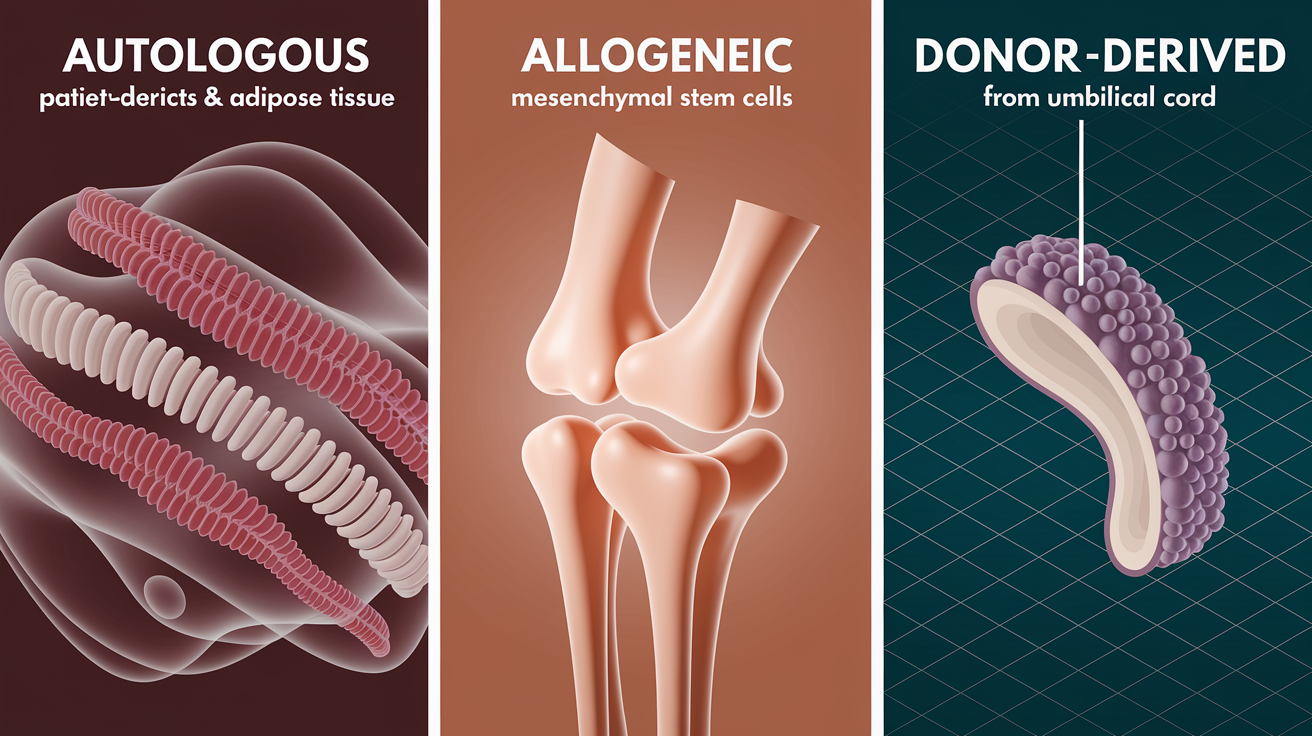
Stem cell treatments for joint pain fall into two main categories: autologous and allogeneic. Autologous treatments use cells taken from your own body, typically from bone marrow or fat tissue. Allogeneic treatments use donor cells, often from umbilical cord tissue or Wharton’s jelly. Each approach has different evidence levels, cost structures, and regulatory considerations. No single type is universally “better” for every patient or condition.
The choice between autologous and allogeneic often depends on your age, the severity of your joint damage, and how quickly you need results. Autologous cells avoid immune rejection risk because they come from your own body, but their potency can decline with age or chronic disease. Allogeneic cells are often younger and may be more potent, but they require rigorous donor screening and sterility testing to reduce infection or immune reaction risk. Some clinics combine both approaches or layer stem cell therapy with platelet-rich plasma (PRP) to improve healing response.
Regulatory status also varies. In the United States, the FDA restricts cell expansion and manipulation, so many high-dose allogeneic programs operate outside U.S. borders. If a clinic offers allogeneic therapy domestically, confirm whether it’s part of an FDA-approved clinical trial or operating under an investigational protocol. Ask the clinic to explain its regulatory status in writing, and verify claims independently through the FDA website or your country’s equivalent regulatory body.
Autologous Stem Cell Therapy
Autologous stem cell therapy uses cells harvested from your own bone marrow or adipose (fat) tissue. Bone marrow is typically extracted from the hip bone (iliac crest) using a needle and syringe under local anesthesia. Fat tissue is collected through a small liposuction procedure, also done with local anesthesia. Once collected, the cells are processed to concentrate the stem cells and growth factors, then injected directly into the affected joint, tendon, or disc on the same day.
This approach is most common for knee osteoarthritis, rotator cuff injuries, hip arthritis, and some spine conditions. Because the cells are your own, the risk of immune rejection is minimal. However, cell potency decreases with age, and patients over 50 or those with significant inflammation or chronic disease may produce fewer viable cells. Ask the clinic how many cells they typically harvest and inject for your condition, and whether they test cell viability before injection. If they can’t answer, that’s a concern.
Allogeneic Stem Cell Therapy
Allogeneic stem cell therapy uses donor cells, most often mesenchymal stem cells (MSCs) derived from umbilical cord tissue or Wharton’s jelly. These cells are typically younger and more potent than cells from older adults, and they can be cultured and expanded in a lab to create high-dose treatments. Clinics may deliver tens of millions to hundreds of millions of cells per treatment, significantly more than most autologous procedures.
Donor cells must meet strict screening standards for infectious disease, genetic defects, and sterility. Ask the clinic for written documentation of donor screening protocols, lab certifications (ISO, GMP), and third-party testing results. Also confirm whether the cells are minimally manipulated or extensively cultured, and whether the treatment is part of a clinical trial or investigational use. Because U.S. FDA rules limit cell expansion, many allogeneic clinics operate internationally. If you’re considering treatment abroad, verify the clinic’s regulatory standing with the host country’s health authority and confirm that aftercare and follow-up will be available when you return home.
How to Verify a Clinic’s Legitimacy

Verification starts with confirming the credentials of the physician who will treat you. Visit your state medical board website (or equivalent national registry) and look up the doctor’s license, board certification, and disciplinary history. Verification usually takes less than five minutes. Check that the board certification is ABMS-recognized and relevant to your condition, such as orthopedic surgery for joint pain, not an unrelated specialty. If the clinic lists multiple physicians, confirm which one will perform your procedure and verify that person specifically.
Next, ask the clinic for written documentation of facility accreditation, lab certifications, and safety protocols. Legitimate clinics will provide copies of GMP compliance certificates, ISO certifications, and third-party audit reports without hesitation. If a clinic says “we follow all regulations” but won’t show you proof, treat that as a red flag. Also ask whether the clinic participates in patient registries or has published peer-reviewed research on outcomes for your condition. Absence of data doesn’t automatically disqualify a clinic, but it means you should demand extra transparency on safety and follow-up.
| Verification Method | What to Look For | Why It Matters |
|---|---|---|
| State Medical Board Lookup | Active license, no restrictions, board certification matches your diagnosis | Confirms the physician is legally authorized and qualified to treat your condition |
| Facility Accreditation Check | Hospital or accredited surgery center, not a spa or retail space | Ensures sterile environment, emergency equipment, and physician oversight |
| Lab Certification Review | ISO, GMP, or equivalent certifications with dates and issuing body | Verifies cell processing meets safety and sterility standards |
| Published Outcomes or Registry Data | Peer-reviewed studies, case series, or registry participation for your condition | Shows the clinic tracks results and shares data, not just marketing claims |
Costs, Success Rates, and What to Expect

Stem cell therapy for joint pain typically costs between $3,000 and $15,000 per treatment, depending on the cell type, dose, clinic location, and whether imaging guidance is used. Autologous bone marrow or fat-derived treatments generally fall at the lower end of that range, while high-dose allogeneic umbilical cord treatments can reach the upper end or beyond. Most insurance plans don’t cover stem cell therapy for joint pain because it’s considered investigational or experimental, so expect to pay out of pocket. Always request a written quote that lists the procedure cost, follow-up visits, imaging fees, and any additional charges like lab processing or facility fees.
Success rates vary widely based on the condition being treated, the severity of joint damage, the quality and dose of cells used, and the skill of the treating physician. Published studies on knee osteoarthritis show that some patients report 30 to 50 percent pain reduction and improved function, while others see minimal benefit. Rotator cuff injuries and hip arthritis have less robust data. Be cautious of clinics claiming success rates above 80 or 90 percent without showing documented outcomes. Real results take time, often weeks to months, not days. If a clinic promises you’ll be “running marathons in a month,” that’s hype, not medicine.
Realistic expectations matter. Stem cell therapy isn’t a guaranteed cure and may not eliminate the need for future surgery or other treatments. Some patients experience meaningful improvement in pain and mobility, allowing them to delay or avoid joint replacement. Others see modest benefit or none at all. Ask the clinic to define success for your condition in measurable terms, such as pain reduction on a scale, improved range of motion in degrees, or return to specific activities. Also confirm the follow-up schedule and whether the clinic tracks and reports long-term outcomes at 6 and 12 months.
Four factors that influence cost and outcomes:
- Cell type and dose. Higher doses of potent allogeneic cells typically cost more and may correlate with faster relief, but evidence varies by condition.
- Condition severity. Mild to moderate arthritis responds better than severe bone-on-bone degeneration. Some patients may not be good candidates.
- Physician skill and imaging guidance. Direct injection into the joint using fluoroscopy or ultrasound improves accuracy and outcomes compared to blind injections.
- Follow-up and adjunct therapies. Clinics that include structured physical therapy, follow-up monitoring, and outcome tracking often report better long-term results than those offering a one-time procedure with no aftercare.
Final Words
If you’re comparing clinics right now, start with the basics: physician credentials, FDA-aligned safety practices, and clear, itemized treatment plans.
Watch for red flags, ask the key questions listed above, and know whether a clinic uses autologous or donor cells. Verify accreditation, published data, and realistic cost and timeline expectations.
Use this guide on how to choose a stem cell clinic for joint pain to make an informed, safety-first decision. Ask for itemized quotes and plan rehab alongside any procedure. You can make a smart choice and get back to what moves you.
FAQ
Q: Where did Joe Rogan get his stem cell treatment?
A: Joe Rogan reportedly received stem cell treatment at a clinic in Mexico; he has mentioned seeking regenerative therapies abroad, though precise clinic details come from his public comments.
Q: Does stem cell therapy work for joint pain?
A: Stem cell therapy for joint pain may help some people, but evidence varies; some patients report reduced pain and better function, while results depend on diagnosis, cell source, and provider skill.
Q: Will insurance pay for stem cell therapy?
A: Insurance typically does not cover stem cell therapy for joint pain; coverage may exist for FDA-approved products or when treatment is part of a clinical trial, so check your policy and ask for preauthorization.
Q: Who is not a candidate for stem cell therapy?
A: People who are not candidates for stem cell therapy include those with active infections, uncontrolled medical conditions (like diabetes), bleeding disorders, certain cancers, or unrealistic expectations; final eligibility needs a physician assessment.