
Is stem cell therapy the answer for osteoarthritis—or mostly clever marketing?
Short answer: the clinical evidence is mixed and more cautious than clinic ads claim.
In this post we walk through randomized trials and systematic reviews, including the MILES trial and Cochrane analysis, to show what actually changes and what doesn’t.
Bottom line: some people report modest, short-term pain and function gains, but high-quality studies don’t show consistent cartilage repair or long-term benefit.
Read on if you want clear takeaways, what to ask your provider, and how to weigh success rates against cost and risk.
Current Scientific Evidence Supporting Stem Cell Therapy in Osteoarthritis

The best evidence we have comes from randomized controlled trials and systematic reviews. And honestly? It’s a lot more cautious than what you’ll see on clinic websites.
Take the MILES multicenter trial, published in Nature Medicine in 2023. Researchers compared bone marrow concentrate, adipose-derived cells, and umbilical cord tissue injections against standard corticosteroid shots for knee osteoarthritis. At 12 months, none of the stem cell treatments showed any significant advantage over steroid injections for pain or functional improvement. Patients in every group, including the steroid group, showed similar modest symptom changes. MRI measurements of cartilage thickness and joint health? No meaningful differences.
The Cochrane Collaboration reviewed 25 randomized trials covering 1,341 patients in 2023. They found small short-term benefits: mean pain improvement of 1.2 points on a 0 to 10 scale and function improvement of 14.2 points on a 0 to 100 scale compared to placebo, measured up to six months. Those improvements are statistically detectable but clinically modest. The review graded the overall evidence as low certainty because of inconsistent study designs, varied cell processing methods, and high risk of bias. Neither the Cochrane review nor the MILES trial found confirmed effects on structural disease progression measured by X-ray or MRI.
Why does evidence remain so mixed? Studies vary wildly in cell source, dose, manufacturing process, injection protocol, patient selection criteria, disease severity at baseline, and choice of control treatment. Some trials compare stem cells to saline placebo, others to hyaluronic acid or platelet-rich plasma, and a few to corticosteroids or usual care. That makes it difficult to pool results or draw firm conclusions about efficacy across real-world clinical settings.
MILES Trial finding: No pain, function, or MRI cartilage advantage at 1 year for bone marrow, adipose, or umbilical cord cells versus corticosteroid injection in knee OA.
Cochrane Review result: Small, short-term symptom improvements (pain −1.2, function +14.2) but low-certainty evidence and no confirmed structural benefit.
MRI and radiographic outcomes: Current trials show no consistent impact on cartilage thickness, joint space narrowing, or disease progression on imaging.
Duration of reported benefit: When improvements occur, most studies report symptom relief lasting 6 to 24 months, not permanent change.
Study variability: Wide differences in cell source, preparation, dosing, comparator group, and outcome measures prevent reliable extrapolation from trial results to commercial treatments.
Stem Cell Therapy Mechanisms Relevant to Osteoarthritis Evidence

The biological rationale centers on what mesenchymal stem cells do after injection, not direct cartilage replacement. MSCs release signaling molecules (cytokines, growth factors, extracellular vesicles) that may reduce joint inflammation, support synovial membrane health, and create a more favorable environment for existing cartilage cells. This paracrine signaling effect is the main mechanism trials test, rather than the idea that injected stem cells turn into new cartilage and rebuild the joint.
Clinical trials emphasize these signaling benefits because durable engraftment and direct cartilage regeneration haven’t been consistently demonstrated. When trial protocols track imaging outcomes or use cartilage biomarkers, the measurable structural changes are minimal or absent, even when patients report modest symptom improvement. That mismatch suggests MSC injections may temporarily modulate the inflammatory environment without reversing the underlying structural wear of osteoarthritis.
| Mechanism | Evidence Status | Notes |
|---|---|---|
| Inflammation reduction | Supported in preclinical models; limited clinical confirmation | Some trials report reduced synovial markers; clinical symptom improvement modest and short-term |
| Synovial support | Proposed; not directly measured in most trials | Hypothesized to improve joint fluid health and reduce swelling; lacks standardized outcome measures |
| Paracrine signaling | Well-documented in lab studies; clinical effect unclear | MSCs release cytokines and growth factors; how much reaches target tissue in vivo is uncertain |
| Cartilage environment improvement | Mixed; MRI and biopsy data show minimal structural change | MILES and Cochrane found no MRI cartilage thickness change; symptom relief may occur without structural repair |
Evidence Across Stem Cell Sources in Knee Osteoarthritis
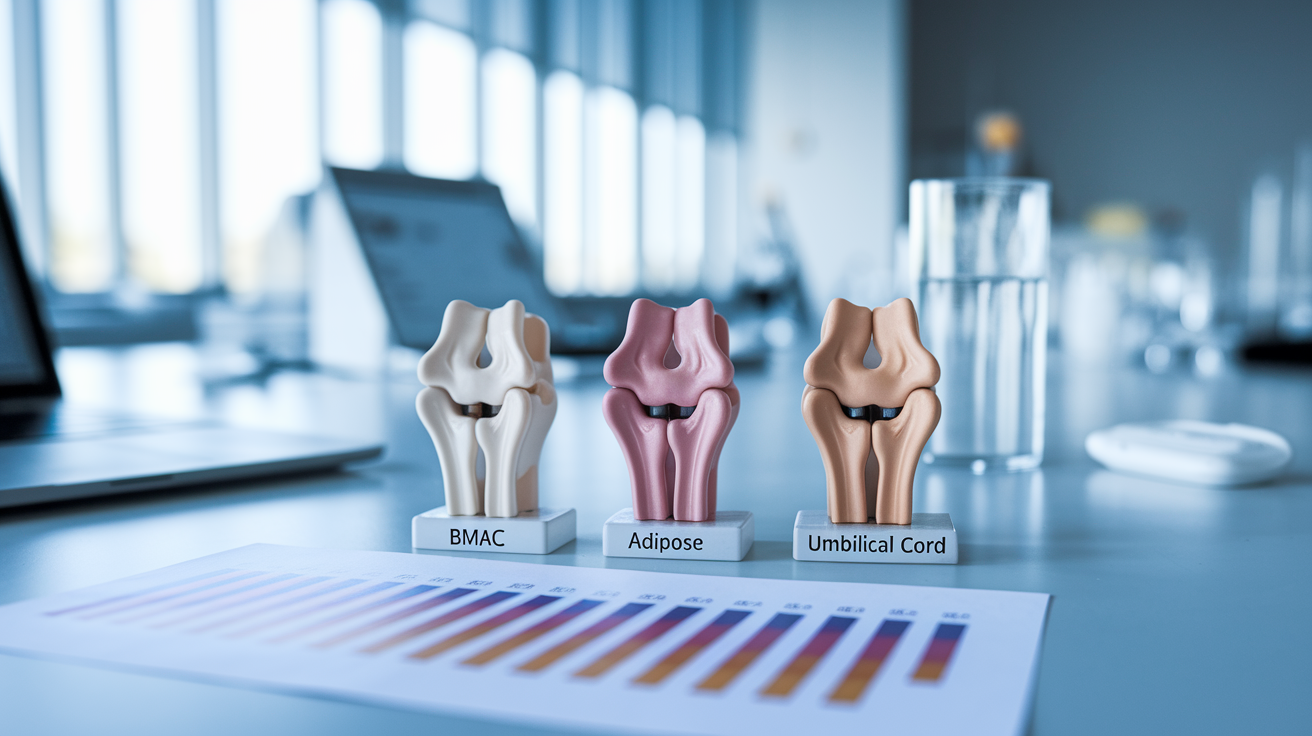
Autologous bone marrow–derived cells are the most studied source for knee osteoarthritis. In the MILES trial, bone marrow aspirate concentrate harvested from the patient’s hip and injected into the knee showed no superiority over corticosteroid injection at one year for WOMAC pain or function scores. MRI measures of cartilage volume and thickness were unchanged. Other smaller randomized trials of BMAC report variable short-term pain improvements, but none have demonstrated durable structural benefit on imaging or halted radiographic disease progression.
Adipose-derived stem cells, typically harvested from the patient’s abdominal fat, have been tested in several small trials. The MILES protocol included adipose-derived cell injections as one of its three stem cell arms. That group also showed no advantage over the steroid comparator at 12 months. Some single-center case series report patient satisfaction and modest symptom relief lasting six to twelve months, but those studies lack blinded controls and standardized processing methods.
Umbilical cord–derived allogeneic cells (particularly from Wharton’s jelly) are marketed widely based on in-vitro data showing strong proliferative capacity and immunomodulatory signaling. In the MILES trial, umbilical cord tissue cells performed no better than the autologous sources or the corticosteroid control. A 2024 systematic review focused on umbilical cord MSCs found some short-term pain and function improvements in small, uncontrolled studies, but the review noted the absence of large, well-designed randomized trials and rated overall certainty as low. Because allogeneic products vary in donor screening, tissue processing, cryopreservation, and viability testing, extrapolating limited trial data to commercial allogeneic injections is unreliable.
Imaging and Structural Evidence for Stem Cell Therapy in Osteoarthritis

MRI endpoints in stem cell trials for osteoarthritis measure cartilage thickness, volume, T2 relaxation times, and synovial inflammation markers. The MILES trial used quantitative MRI to track cartilage outcomes at 12 months and found no statistically significant differences between any of the stem cell groups and the corticosteroid control. Cartilage thickness changes were minimal across all groups. There was no evidence that MSC injections slowed structural decline or promoted measurable cartilage regrowth.
The Cochrane 2023 review aggregated imaging data from included trials and concluded that current evidence doesn’t confirm an effect on radiographic disease progression. Standard X-ray measures (joint space width, osteophyte formation, and Kellgren-Lawrence grade) showed no consistent change attributable to stem cell therapy. A few individual studies reported statistically significant improvements on MRI subscales or composite scoring systems, but those findings came from small samples with high risk of bias and weren’t replicated in larger, better-controlled trials.
MRI cartilage change: MILES and most rigorous RCTs show no meaningful increase in cartilage thickness or volume; imaging improvements reported in some studies are often small, inconsistent, and not replicated in higher-quality trials.
Radiographic progression: Cochrane review found no confirmed impact on joint space narrowing or osteophyte formation; X-ray endpoints remain unchanged in controlled trials.
Biomarkers used: Trials measure cartilage oligomeric matrix protein (COMP), interleukin-6, and other inflammatory markers; results are inconsistent and don’t correlate reliably with symptom improvement.
Inconsistencies: Heterogeneity in imaging protocols, timing of scans, and analysis methods across trials prevents pooling of structural outcome data and limits confidence in any single positive finding.
Safety Evidence and Adverse Events in Stem Cell Therapy for Osteoarthritis

Safety data from randomized trials and systematic reviews generally show that autologous stem cell injections for osteoarthritis have a favorable short-term safety profile. The most commonly reported adverse events are transient post-injection swelling, soreness, and temporary worsening of joint pain, which typically resolve within a few days to weeks. The 2024 systematic review on safety and complications found no signal of major procedural complications (such as septic arthritis or systemic infection) in the included studies, though moderate rates of transient local symptoms were noted.
Allogeneic products, particularly those derived from umbilical cord or amniotic tissue, carry additional theoretical risks related to donor screening, tissue processing, and immune response. The FDA has issued consumer alerts following reports of serious adverse events linked to unapproved regenerative medicine products, including infections and inflammatory reactions. Because many commercially marketed “stem cell” products don’t match the exact formulations tested in published trials, real-world safety profiles may differ from what appears in peer-reviewed literature.
Autologous minimally manipulated cells harvested and re-injected during the same procedure appear to have the lowest risk of serious complications in the available evidence. Even so, any intra-articular injection carries inherent procedural risks (infection, bleeding, pain flare) and patients with uncontrolled infection, active malignancy, or certain clotting disorders are typically excluded from trials. Safety monitoring and standardized adverse-event reporting remain inconsistent across studies, and long-term safety data beyond 24 months are sparse.
Evidence for Stem Cell Therapy in Hip Osteoarthritis

Evidence for stem cell therapy in hip osteoarthritis is considerably weaker than for knee OA. Most studies are small, uncontrolled case series or retrospective cohort reports with limited follow-up periods. A few publications describe autologous bone marrow concentrate injections for hip arthritis and report statistically significant improvements in pain and function scores at six to twelve months, but those studies lack randomized controls, blinded assessments, or standardized cell processing protocols.
No large randomized controlled trials comparable to the MILES knee trial have been published for hip osteoarthritis. The available case series suggest some patients report short-term symptom relief, but the absence of placebo or sham comparator groups makes it impossible to separate treatment effect from natural fluctuation, placebo response, or concurrent physical therapy and activity modification. The hip joint’s deeper anatomical position and different biomechanical loading patterns may affect cell delivery, retention, and therapeutic signaling compared to the knee, but those differences haven’t been systematically studied.
Study quality: Predominantly small uncontrolled series; no high-quality RCTs comparable to knee OA trials.
Reported outcomes: Some short-term pain and function score improvements at 6 to 12 months; durability and structural benefit unconfirmed.
Unknown factors: Lack of imaging endpoints, standardized cell preparation, dose optimization, and long-term follow-up data for hip OA limits clinical recommendations.
Systematic Reviews and Meta-Analyses on Stem Cell Therapy for Osteoarthritis

Systematic reviews and meta-analyses attempt to synthesize heterogeneous trial data to estimate overall treatment effect. The 2023 Cochrane review is the most comprehensive, pooling 25 randomized trials with 1,341 patients and finding small, short-term improvements in pain and function compared to placebo or no treatment. But the review rated the certainty of evidence as low because of widespread risk of bias, inconsistent outcome measures, variable cell sources, and lack of standardized dosing or manufacturing protocols across studies.
A 2024 meta-analysis focused on patient-reported outcomes across multiple stem cell sources also found modest improvements in WOMAC and visual analog scale pain scores at short-term follow-up, but reported wide confidence intervals and significant heterogeneity between studies. When the analysis was restricted to trials with lower risk of bias (those using true placebo controls, blinded outcome assessors, and pre-registered protocols), the effect sizes shrank and in some comparisons became statistically non-significant.
Higher-level re-evaluations applying stricter methodological standards have concluded that MSC injections may provide little to no meaningful clinical improvement for chronic knee osteoarthritis pain. Those analyses highlight that many positive findings in earlier reviews came from small, unblinded studies at high risk of performance and detection bias. When only rigorous RCTs with sham controls are pooled, the aggregate evidence doesn’t support routine clinical use.
| Review | Sample Size | Key Findings | Certainty |
|---|---|---|---|
| Cochrane 2023 | 25 RCTs, 1,341 patients | Small short-term improvements: pain −1.2/10, function +14.2/100 vs placebo up to 6 months; no structural benefit confirmed | Low |
| 2024 meta-analysis (PROMs focus) | Multiple sources, varied n | Modest WOMAC/VAS improvements; wide confidence intervals; high heterogeneity; effect smaller in lower-bias subset | Low to moderate |
| Higher-level re-evaluation (strict inclusion) | Subset of sham-controlled RCTs | Little to no meaningful clinical improvement when only rigorous trials pooled; many positive findings attributable to bias | Moderate |
Guideline and Regulatory Evidence on Stem Cell Therapy for Osteoarthritis

The U.S. Food and Drug Administration hasn’t approved any stem cell product specifically for knee or hip osteoarthritis as of May 2025. Legally permissible autologous cell procedures are limited to minimally manipulated, same-surgical-procedure uses performed by licensed physicians. The FDA has issued repeated warnings about clinics marketing unapproved stem cell “cures” for arthritis and other degenerative conditions. After serious adverse events linked to unapproved regenerative products, the FDA published consumer alerts advising patients to confirm regulatory status and ask detailed questions about product sourcing, processing, and clinical evidence before paying out-of-pocket fees.
Major orthopedic professional societies have issued cautious or negative recommendations. The American Association of Hip and Knee Surgeons stated in 2019 that biologic therapies including stem cell and PRP injections can’t be recommended for routine treatment of advanced hip or knee arthritis due to limited high-quality evidence of superiority over standard care and significant cost burdens. The American Academy of Orthopaedic Surgeons clinical practice guideline, third edition published in 2021, found insufficient evidence to recommend for or against stem cell injections for knee osteoarthritis, neither endorsing nor prohibiting the practice but emphasizing the lack of definitive data.
The UK National Institute for Health and Care Excellence released guideline NG226 in 2023, which doesn’t recommend routine use of stem cell injections for knee or hip osteoarthritis and calls for more high-quality research before widespread clinical adoption. NICE emphasized that first-line management should remain conservative measures (exercise, weight management, physical therapy, and NSAIDs), with joint replacement reserved for advanced disease when conservative options fail. Together, these regulatory and professional positions reflect consensus that stem cell therapy for osteoarthritis remains investigational and shouldn’t be presented as an established standard of care.
Patient-Reported Outcomes and Functional Evidence in Clinical Trials

Patient-reported outcome measures, especially the Western Ontario and McMaster Universities Osteoarthritis Index (WOMAC) and the visual analog scale for pain, are the primary endpoints in most stem cell trials. The WOMAC assesses pain, stiffness, and physical function on standardized subscales, while VAS captures pain intensity on a 0 to 10 numeric scale. Trials reporting WOMAC improvements typically show short-term reductions in pain and stiffness subscores at three to six months, with mean improvements in the modest range (often 10 to 20 points on the 0 to 100 function scale).
Across aggregated studies, approximately 67 percent of trials reporting patient-reported outcome measures documented at least a two-fold improvement in some measure compared to baseline or control. But those findings are tempered by small sample sizes, lack of blinding, and inconsistent follow-up schedules. Many studies show that any benefit peaks within the first six months and diminishes or disappears by 12 to 24 months, suggesting that symptom relief is temporary rather than disease-modifying.
WOMAC pain subscale: Typical short-term improvements of 1 to 2 points on a 0 to 10 scale; clinically meaningful threshold debated but often set at ≥2 points; many trial results fall below that threshold.
VAS pain scores: Some studies report statistically significant reductions at three to six months; effect size small and not sustained at longer follow-up in controlled trials.
Functional capacity measures: KOOS and other instruments show modest short-term gains in daily activity subscales; improvement in high-demand activities (running, kneeling) rarely reported.
Durability of benefit: Most positive findings are limited to six to twelve months; few trials show persistent improvement beyond 24 months; no confirmed long-term disease modification on imaging or clinical exam.
Remaining Evidence Gaps and Future Research Directions for Stem Cell Therapy in Osteoarthritis

Standardization of cell preparation, dosing, and delivery remains a critical unmet need. Published trials use widely varying methods for cell harvest, culture expansion, concentration, viability testing, and injection technique. That makes it nearly impossible to identify an optimal protocol or compare results across studies. Without agreed-upon standards for MSC potency, dose per kilogram or per joint volume, and quality control, trial findings can’t be reliably translated into consistent clinical practice or regulatory approval pathways.
We need large, adequately powered randomized controlled trials with blinded sham controls, standardized MRI and radiographic endpoints, and follow-up extending beyond 24 months. Most existing studies are underpowered to detect clinically meaningful differences, and many lack true placebo controls or independent, blinded outcome assessment. Long-term structural data (whether stem cell therapy slows cartilage loss, delays the need for joint replacement, or alters disease trajectory) are absent from current literature, leaving a fundamental question about disease modification unanswered.
Dose-ranging studies to determine the minimum effective cell number and optimal injection frequency haven’t been systematically conducted. Some trials use single injections, others use two or three doses spaced weeks apart, and commercial clinics may offer variable “booster” schedules without supporting evidence. Until rigorous dose-response trials establish clear efficacy thresholds and durability curves, both patients and clinicians are left to make decisions based on incomplete and inconsistent data.
| Research Gap | Why It Matters | Current Status |
|---|---|---|
| Standardization of cell preparation and dosing | Enables comparison across trials, replication of positive findings, and regulatory evaluation | No consensus protocols; wide variability in harvest, processing, viability, and dose; commercial products often differ from trial formulations |
| Large, long-term RCTs with MRI and X-ray endpoints | Answers whether stem cells modify disease structure, delay joint replacement, or only provide temporary symptom relief | Most trials underpowered, short follow-up (≤12 months), lack blinded structural outcomes; no confirmed structural benefit in high-quality trials |
| Dose-ranging and injection-frequency optimization | Determines minimum effective dose, cost-effectiveness, and whether repeat injections add durable benefit | No systematic dose-response studies; injection schedules vary widely; commercial “booster” protocols lack evidence base |
Final Words
High-quality trials and reviews show only small, short-term symptom improvements and no clear cartilage or imaging benefit. The strongest studies, including MILES and the Cochrane review, rate the evidence as low or mixed.
That uncertainty comes from different cell sources, doses, and small trial sizes. Safety looks acceptable for autologous approaches, but avoid unapproved products and expect transient soreness.
Use the evidence for stem cell therapy for osteoarthritis to ask clear questions, compare itemized costs, and keep building strength, mobility, and sleep. Those basics still move the needle, and you can choose cautiously with more confidence.
FAQ
Q: What does the best current evidence say about stem cell therapy for knee osteoarthritis?
A: The best current evidence says randomized trials and reviews find no clear long-term benefit; some small short-term symptom gains, but overall evidence is low certainty and mixed.
Q: Are there short-term benefits for pain and function from stem cell therapy?
A: Short-term benefits for pain and function can occur, with small average improvements reported, but these changes are modest, vary by study, and confidence in the effect is low.
Q: Do stem cells rebuild cartilage or change MRI or X-ray findings?
A: Stem cells do not reliably rebuild cartilage or change MRI/X-ray findings; trials show no confirmed structural improvement and benefits seem driven by signaling, not true tissue regrowth.
Q: Does the stem cell source (bone marrow, adipose, umbilical) affect outcomes?
A: The stem cell source may matter in theory, but trials like MILES found bone marrow, adipose, and umbilical products showed no superior outcomes at one year versus corticosteroid.
Q: What are the main safety risks and side effects of stem cell injections?
A: The main safety risks are transient swelling and soreness; rare serious harms have occurred with unapproved products—autologous sources appear safer. Confirm product approval and clinic practices before proceeding.
Q: What evidence exists for stem cell therapy in hip osteoarthritis?
A: Evidence for hip osteoarthritis is limited to small, mostly uncontrolled studies showing short-term symptom changes; lack of randomized trials prevents firm conclusions about effectiveness or durability.
Q: What do systematic reviews and meta-analyses say about efficacy?
A: Systematic reviews and meta-analyses report small, short-term benefits with low certainty; stricter analyses and higher-quality trials tend to show minimal or no meaningful advantage.
Q: How long do any benefits from stem cell treatment usually last?
A: Any benefits usually last months, often fading by 6 to 24 months in most studies; long-term symptom relief and structural improvement are not consistently demonstrated.
Q: What should patients ask providers before considering stem cell therapy?
A: Patients should ask about provider credentials, product type and source, dose and processing, evidence for their condition, MRI endpoints, follow-up care, costs, and refund or complication policies.
Q: What research gaps remain and what studies are needed next?
A: Remaining gaps include standardized cell processing, larger randomized trials with MRI endpoints, long-term follow-up, and dose optimization to clarify who, if anyone, benefits.